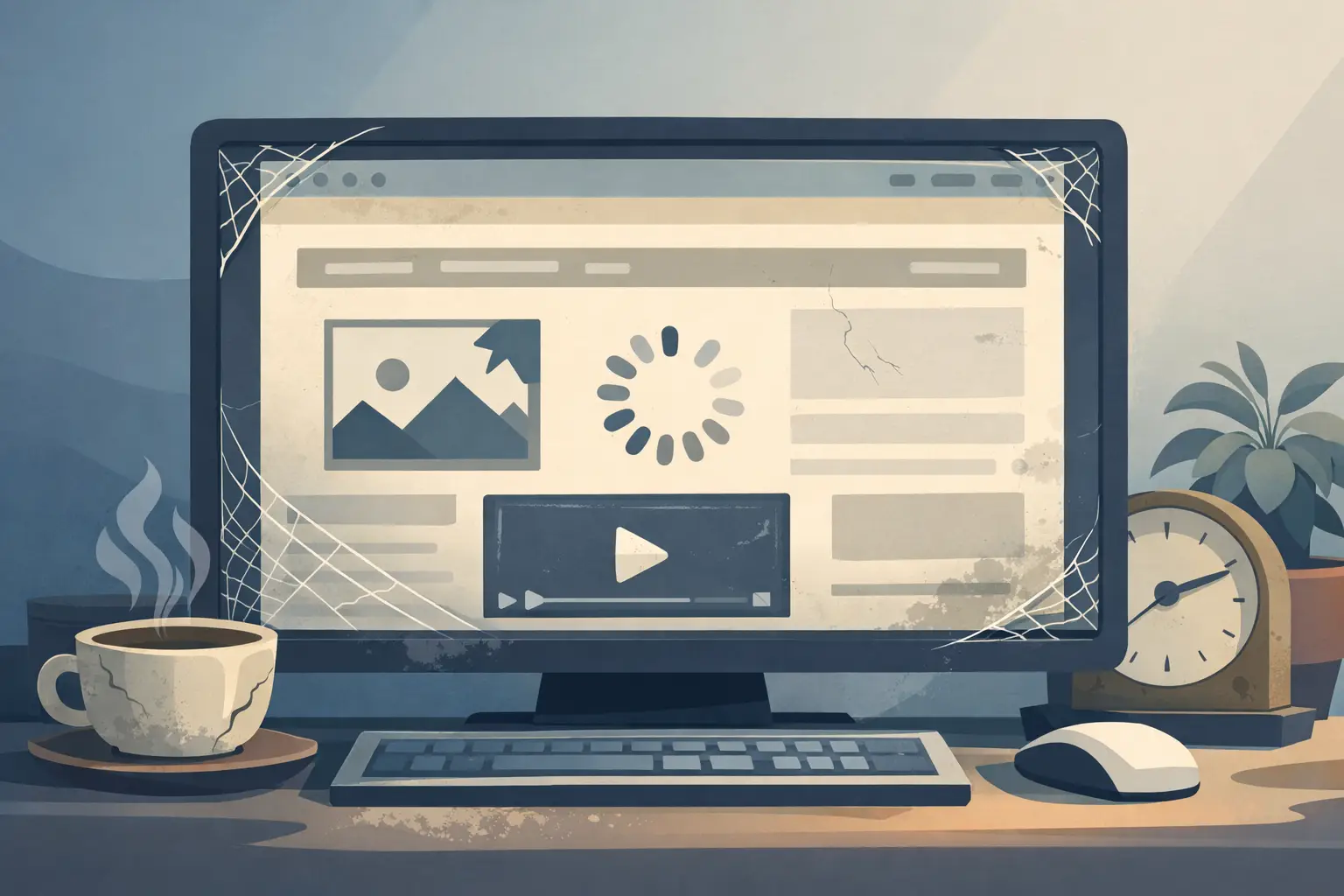
You can usually feel it before you can explain it. A prospect lands on your site, clicks around for a few seconds, then disappears. You look at the homepage and think, nothing is technically broken, so why your website feels outdated is hard to pin down. But your visitors know. They feel the drag, the confusion, the hesitation, and they leave before they ever become a lead.
That outdated feeling is rarely about one ugly font or an old stock photo. It is usually the result of small signals stacking up until the whole site starts leaking trust. And when trust drops, conversion drops right behind it. This is where a lot of small businesses get stuck. They think they need a cosmetic refresh, when what they really need is a site that performs like a salesperson instead of a flyer.
Why your website feels outdated even if it still works
A website can be functional and still feel behind. Plenty of business owners confuse operational with effective. The contact form submits. The pages load eventually. The navigation exists. Technically, the machine turns on. But if the site feels slow, vague, cluttered, or disconnected from how people buy today, visitors read that as stale.
People judge your business fast. Not because they are shallow, but because they are busy. They are comparing you against every sharp, fast, easy digital experience they had this week. That includes other companies in your market, but it also includes online stores, booking platforms, and service businesses with cleaner systems. Your website is not judged in isolation. It is judged against modern expectations.
An outdated website tells visitors a few dangerous things. Maybe this business is not paying attention. Maybe communication will be slow. Maybe the service is behind the times too. That may be unfair, but it is how buying decisions work. Design is not decoration. It is a trust signal.
The real reasons your website feels outdated
Your messaging sounds generic
This is one of the biggest offenders, and it has nothing to do with color palettes. If your homepage says things like quality service, trusted solutions, or we care about our customers, you are blending into the wallpaper.
Modern websites speak clearly and quickly. They tell the right visitor exactly what you do, who it is for, and what to do next. If someone has to hunt for that information, the site feels old because it behaves like an online brochure from a different era.
Sharp messaging feels current because it respects attention. Vague messaging feels outdated because it makes the visitor do the work.
Your layout reflects old browsing habits
A lot of older sites were built for businesses, not buyers. They open with giant welcome paragraphs, long menus, sidebars, sliders, and pages packed with equal-weight information. That structure comes from a time when websites were expected to hold everything at once.
Today, users want a clear path. They scan, they scroll, and they make quick decisions. A modern layout guides attention. It prioritizes the headline, the offer, proof, and the next step. If every section screams for attention or nothing is clearly prioritized, the site feels stale fast.
Your mobile experience is an afterthought
This one is brutal because business owners often review their site on a desktop while their customers are checking it on a phone in a parking lot, between meetings, or from the couch at night.
If buttons are cramped, text is tiny, forms are annoying, or sections stack awkwardly, the site instantly feels old. Mobile usability is no longer a bonus. It is the baseline. A site that does not feel smooth on a phone feels like a business that is behind.
It loads slowly and drags the whole experience down
Speed changes perception. A slow website feels outdated even if it looks decent. Delay makes people suspicious. They may not know whether the problem is your hosting, your oversized images, bloated plugins, or clunky code. They just know it feels inefficient.
And that matters because slow sites do not just annoy people. They waste traffic you already paid for. If you are running ads, posting on social, or investing in SEO, every slow page is a tax on your marketing.
The visuals are inconsistent or overdesigned
Some sites look outdated because they have not changed in years. Others look outdated because they chased too many trends at once. A dated site might use old icons, awkward spacing, weak photography, and mismatched typography. But an overdesigned site can feel just as bad if it is full of animations, effects, and design choices that distract from the sale.
Modern design is usually simpler than people expect. Cleaner spacing. Better hierarchy. Stronger imagery. Fewer distractions. The goal is not to impress a designer. It is to help a customer feel confident enough to take action.
There is no proof that you are the right choice
A website feels outdated when it talks about the business but says very little about results. Visitors are looking for signs that real people trust you. Reviews, case studies, before-and-after examples, recognizable clients, certifications, and clear outcomes all help.
Without that proof, the site feels thin. And thin feels old because modern buyers expect evidence. They do not want claims. They want receipts.
Outdated design is usually a conversion problem in disguise
This is the part many businesses miss. When people say a site feels outdated, they are often reacting to friction more than aesthetics.
A modern website reduces uncertainty. It answers obvious questions before they are asked. It makes navigation easy. It creates momentum. It gives people a reason to keep going.
An outdated site creates hesitation at every step. The offer is unclear. The calls to action are weak. The page structure is messy. The form asks for too much. The trust signals are buried. The business sounds fine, but not compelling.
That is why a redesign that only changes the visuals often underperforms. The paint is fresh, but the leaks are still there. If the strategy, messaging, page flow, and technical setup do not improve, the site may look newer while still converting like an old one.
How to tell if your website is costing you business
You do not need to be a web expert to spot the warning signs. If people visit but do not contact you, if traffic is decent but leads are weak, or if you feel slightly embarrassed sending prospects to your site, pay attention.
Another clue is when your business has evolved but your website has not. Maybe your services are more premium now. Maybe your customer base is more specific. Maybe your pricing, positioning, or process has matured. If the website still reflects an older version of the business, it creates a mismatch. That mismatch makes the whole experience feel behind.
It also shows up in your sales process. Are prospects asking basic questions that should already be answered online? Are leads poorly qualified? Are people price-shopping because your value is not obvious? Those are website problems as much as sales problems.
What a modern website actually needs
A modern site is not defined by trendy visuals. It is defined by performance.
It should load fast, look strong on mobile, and make your offer clear in seconds. It should guide visitors toward the next step without forcing them to think too hard. It should back up your claims with proof and present your business like it knows exactly who it serves.
That does not mean every site needs to be stripped down and minimalist. It depends on your audience, your service, and how much education the sale requires. A law firm, med spa, contractor, and fitness brand will not need the same page structure. But they all need clarity, trust, speed, and a path to conversion.
If your market is competitive, modern also means strategic. Your website should not just look current. It should help you win. That might mean stronger local SEO structure, better landing pages, tighter calls to action, cleaner service pages, or a faster hosting setup. The right fixes depend on where the leaks are.
Fix the feeling, not just the facade
If your site feels outdated, resist the urge to jump straight into a visual facelift. Start by asking tougher questions. Is the messaging clear? Is the offer compelling? Is the mobile experience smooth? Does the site build trust fast? Does it help people take the next step, or does it just sit there looking official?
That is the difference between a website that takes up space and one that pulls its weight.
A good redesign should make your business easier to understand, easier to trust, and easier to choose. That is the standard. Anything less is just rearranging the furniture.
And if your website has been quietly bleeding leads for months, this is not a branding problem. It is a revenue problem. The good news is that once you see what is making the site feel old, you can fix it with purpose instead of guesswork. That is where real growth starts.