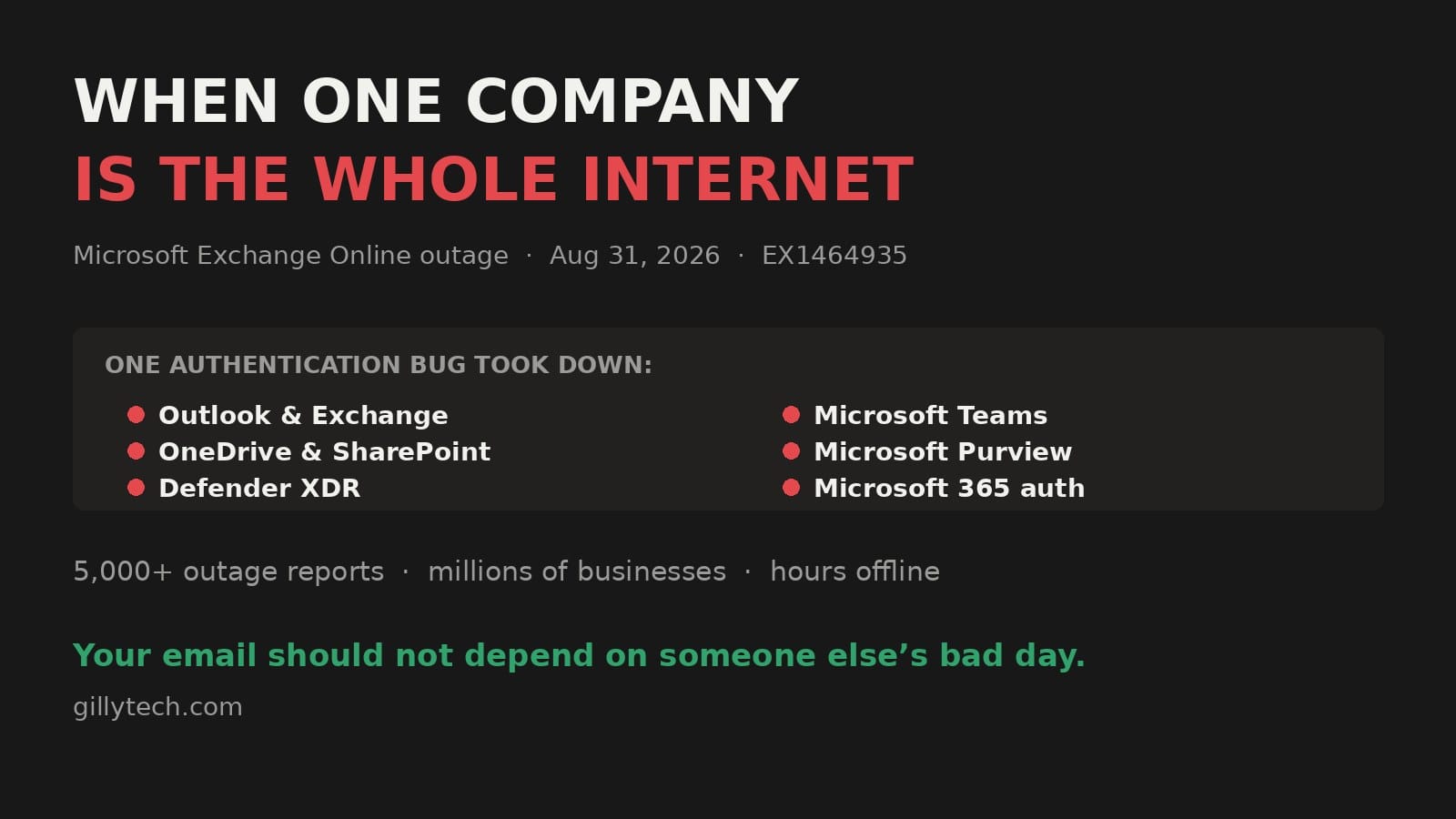
On Monday, a single misconfigured authentication component inside Microsoft’s cloud took down email for a meaningful slice of the business world. Outlook and Exchange Online started failing around 11:30 AM Eastern, and by early afternoon Downdetector was logging more than 5,000 reports. Messages would not send or arrive, searches failed, and users were locked out with authentication errors for hours.
Microsoft tracked it as incident EX1464935 and later MO1465074, and pinned the cause on “a core authentication configuration used by multiple internal services.” That phrase is the whole story, so sit with it for a second.
One Bug, Six Products, Millions of Businesses
Because so many Microsoft services lean on the same shared authentication layer, one configuration problem did not just break Outlook. The same incident rippled into Microsoft Teams, OneDrive for Business, SharePoint Online, Microsoft Purview, and Microsoft Defender XDR. Email, chat, files, and security tooling, all degraded at once, all traceable to one component in one company’s infrastructure.
This is the hidden cost of the all-in-one megaplatform. The convenience of having everything under one login is also the fragility of having everything behind one point of failure. When the platform that runs your email, your documents, your calls, and your security dashboard has a bad morning, you do not lose one tool. You lose your whole desk.
Too Much of the Internet Runs on Too Few Companies
Step back and the pattern is hard to miss. A handful of omni-tech giants now sit underneath a startling share of the internet. We watched GitHub freeze developers worldwide, Proton take mail, calendar, drive, and passwords offline together, and Cloudflare repeatedly break large chunks of the web, which is why we keep writing about building a resilient stack. Now Microsoft. Different logos, identical lesson: when the substrate is this concentrated, everyone downstream inherits the outage.
None of these companies is incompetent. They employ some of the best engineers alive. The problem is not skill, it is concentration. A configuration change that would inconvenience one small business instead cascades across millions, because millions all rent from the same landlord.
And email is the worst place to accept that risk. Your inbox is where invoices land, where clients reach you, where password resets arrive. When it goes dark for half a day, the cost is not “annoying,” it is deals stalled and customers wondering if you disappeared.
The Alternative Is Not Bigger. It Is Independent.
The instinct after an outage like this is to look for a different giant to hide behind. That just changes whose authentication bug ruins your Tuesday. The real fix is to stop routing something as critical as your business email through infrastructure you neither control nor can route around.
GillyTech runs business email hosting that is deliberately built the opposite way from a hyperscale megaplatform. It runs on independent, monitored infrastructure with layered MX records, so mail keeps flowing on backup paths instead of bouncing when a primary node has trouble. It is not chained to a shared authentication fabric that also happens to power six other products for a billion people. When Microsoft, Google, or the next giant has an incident, our clients read about it in the news rather than living through it.
It is also genuinely affordable. You do not need hyperscaler pricing to get email that stays up. You need email on your own domain, run by people who treat uptime as their job rather than a rounding error across a trillion-dollar product line. That is the entire pitch: resilient, independent, priced for real businesses, and immune to big tech’s bad days because it simply is not part of their infrastructure.
What This Should Change for You
- Put your email on your own domain. If your address ends in a giant’s domain, you cannot move without changing your identity. On your own domain, switching providers is a DNS change, not a crisis, as our DNS guide explains.
- Do not bundle every critical system behind one login. Convenience is real, but so is correlated failure. Independence between your email, files, and communication tools means one outage cannot take all three.
- Ask who is actually responsible for your uptime. On a megaplatform, you are one of a billion tickets. With a focused provider, you are a client with a name.
Microsoft restored service, as they always do. But the next outage is already scheduled, we just do not know the date. The question worth answering before then is whether your business email has to go down with it.
Tired of your email depending on someone else’s authentication server? GillyTech offers affordable, resilient business email on independent infrastructure that big-tech outages simply cannot touch. Schedule a call and we will move you off the megaplatform without missing a message.

Cost Management
Microsoft 365 Is Down Again. Why Does One Company’s Bad Day Stop the World’s Email?
Sep 1, 2026
Web Consulting
Microsoft Outlook Went Dark for Hours. Too Much of the Internet Runs on Too Few Companies.
Sep 1, 2026