Every business has a software stack, even if nobody calls it that.
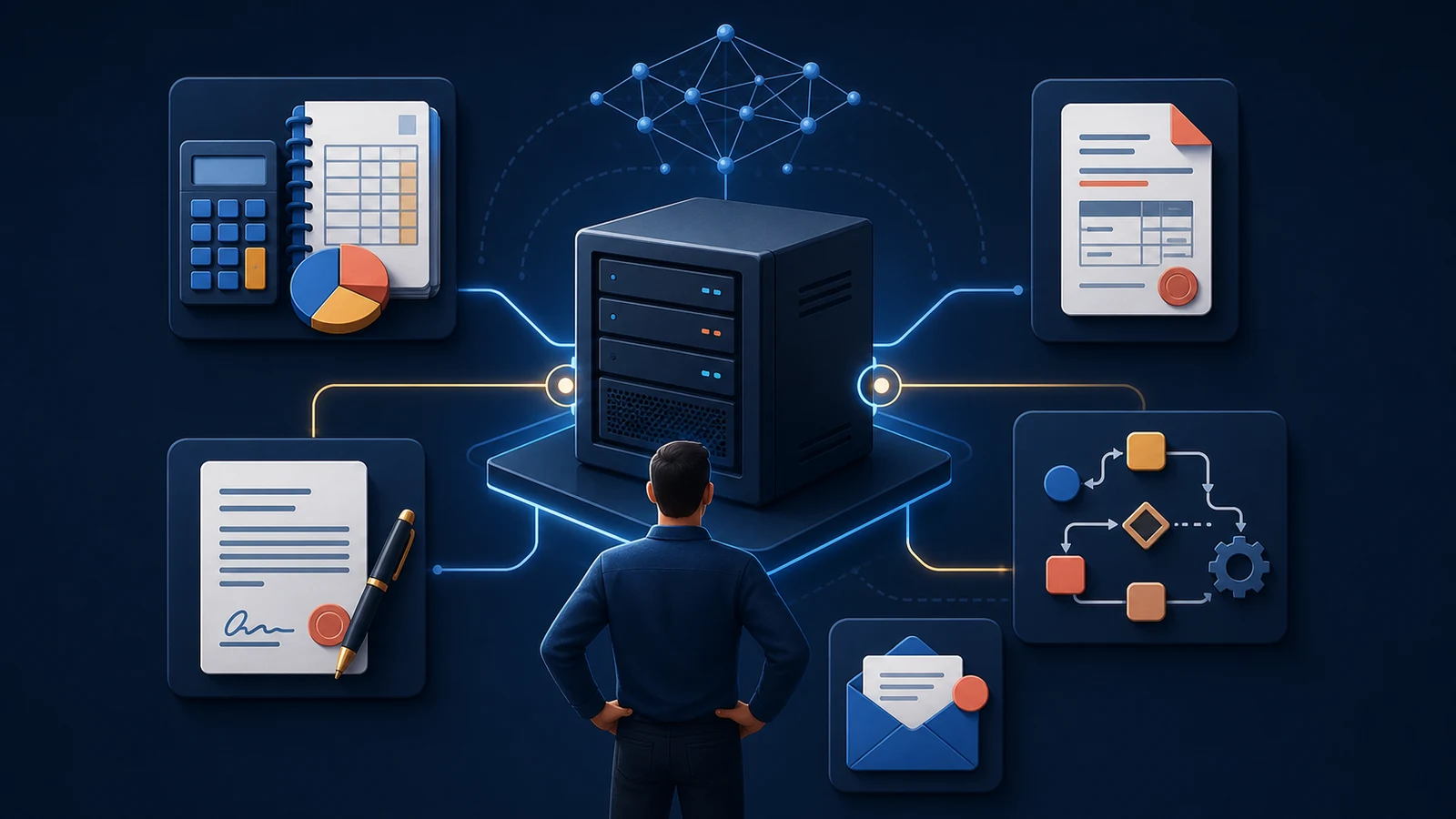
It is your accounting software, invoicing system, email platform, document-signing tool, website, customer database, and all the automations connecting everything together.
For years, the standard advice was simple: pay for a bunch of online services and let somebody else handle the technical work.
That can still be the right choice. We use third-party services too. But businesses have become extremely dependent on software they do not own and cannot control.
The price goes up? Pay it.
A feature disappears? Work around it.
The company changes its rules? Accept them.
Your account gets flagged by mistake? Open a support ticket and hope a human eventually reads it.
That is why self-hosting is worth another look.
What Self-Hosting Actually Means
Self-hosting means running software in an environment you control instead of renting access to a vendor’s hosted version.
That does not necessarily mean keeping a loud server in the corner of your office. You can self-host software on private cloud infrastructure, a virtual private server, dedicated hardware, or a managed environment maintained by someone you trust.
The important part is control.
You decide where the software runs. You control the data. You decide when to update it. You can move it, modify it, connect it to other tools, and keep using it without asking a software company for permission.
Why This Matters More in the AI Era
AI makes software more useful, but it also makes your business data more valuable.
Your documents, emails, invoices, customer conversations, internal processes, and automations contain years of business knowledge. Once all of that is spread across a dozen software companies, it becomes difficult to know where the data is going, how it is being processed, and how easily you can get it back.
AI also makes it easier for software companies to add new features quickly. That sounds great until an important part of your workflow changes overnight or gets moved into a more expensive plan.
When you control the software, you have more say over how AI is used and which information it can access.
You do not need to reject cloud software or AI. You just need to stop handing over control by default.
What We Self-Host at GillyTech
We do not talk about self-hosting as a theory. We use it in our own business.
Accounting and Invoicing
We self-host software for accounting and invoicing.
That gives us control over our financial records, client information, invoices, payment history, and reporting. We are not forced to rebuild our process every time a software company changes its pricing or decides a useful feature now belongs in a more expensive plan.
It also makes it easier to connect invoicing with the rest of our internal systems.
Document Signing
We self-host our document-signing software.
Proposals, agreements, and signatures are important business records. Running the software ourselves gives us more control over where those documents live and how long we keep them.
Clients still get a simple signing experience. The difference is what happens behind the scenes.
Automations
We self-host our automation software too.
Automations move information between forms, websites, email, project systems, and internal tools. They are often the glue holding a modern business together.
When that glue belongs entirely to another company, one price change or platform problem can affect several parts of the business at once.
Self-hosting gives us more freedom to build automations around the way we actually work. We can create custom workflows without worrying as much about task limits, locked features, or whether a vendor supports an unusual connection.
Email Software
We even self-host email software.
That does not mean every part of email delivery has to happen from a server under our desk. It means we control the software used to manage important email functions instead of placing the entire process inside one closed platform.
This gives us more flexibility over lists, templates, sending rules, integrations, and data. We can still use specialized delivery services when they make sense without giving one vendor control over the whole system.
The Real Benefits of Owning More of Your Stack
More Control
You decide how the software works, when it gets updated, and what it connects to.
If a feature is important to your business, you are not waiting for a product manager at another company to approve it.
Better Data Ownership
Your business data stays in systems you control. You can back it up, export it, move it, and set your own retention policies.
You should still secure it properly, of course. Owning the data also means owning the responsibility.
Fewer Surprise Price Increases
Self-hosted software is not free. You still pay for infrastructure, maintenance, backups, and technical support.
The difference is that the cost is tied more closely to what you actually use. You are less likely to wake up to a new per-user fee because a vendor decided your team looked profitable.
More Flexible Automations
Owning the main pieces of your stack makes it easier to connect them.
Your website can talk to your invoicing system. A signed agreement can trigger onboarding. A completed form can create a task, send an email, and update a client record.
You are building around your business instead of bending your business around somebody else’s software.
Less Vendor Lock-In
No software lasts forever.
Companies get acquired. Products shut down. Pricing changes. Features disappear. Support gets worse.
Self-hosting does not eliminate every risk, but it gives you more options when something changes.
Self-Hosting Is Not Automatically Better
There is a tradeoff here.
Somebody has to maintain the server, install updates, monitor security, test backups, and fix problems. If nobody is responsible for those jobs, you do not own a software stack. You own a future emergency.
That is why we do not recommend self-hosting everything just because it is possible.
A hosted service may be the better choice when:
- The service is inexpensive and works well.
- It does not hold sensitive or critical information.
- Moving away later would be easy.
- You do not have anyone qualified to maintain a self-hosted replacement.
- The vendor provides security, compliance, or reliability you cannot reasonably match.
The goal is not to eliminate every subscription. The goal is to make deliberate choices.
A Hybrid Stack Usually Makes the Most Sense
For most businesses, the smartest setup is a mix of self-hosted and managed services.
Self-host the systems where control, privacy, flexibility, or long-term cost matter most. Continue using hosted services where they save time and genuinely earn their monthly fee.
You can also self-host the main application while using outside providers for specific jobs. For example, you might control your email software while using a specialized service to deliver messages reliably.
It does not need to be all or nothing.
How to Start Owning More of Your Stack
Start with an inventory of the software your business pays for.
For each tool, ask:
- What information does this tool hold?
- What would happen if the price doubled?
- Could we export our data in a useful format?
- How hard would it be to replace this tool?
- Does it connect to other critical systems?
- Who would maintain a self-hosted alternative?
Do not start by replacing the most complicated system in the company. Pick one tool where the benefit is clear and the risk is manageable.
Document the setup. Create reliable backups. Test the backups. Assign responsibility for updates and security.
Then decide whether the next replacement is worth doing.
Ownership Is Leverage
Self-hosting is not about being anti-cloud, anti-AI, or anti-software company.
It is about leverage.
The more control you have over the systems running your business, the more choices you have when prices rise, policies change, or a vendor stops meeting your needs.
We self-host accounting, invoicing, document signing, automations, and email software because those systems matter to how we operate. Owning them gives us the freedom to build better processes without stacking up endless subscriptions or handing every piece of the business to somebody else.
Use hosted software when it serves you well. Own the parts that give your business an advantage.
And most importantly, make the choice on purpose.
Need help figuring out what your business should self-host? GillyTech can audit your current software stack, identify expensive or risky dependencies, and help you build a setup that gives you more control without creating more work. Schedule a 15-minute call.


Cost Management
Microsoft 365 Is Down Again. Why Does One Company’s Bad Day Stop the World’s Email?
Sep 1, 2026