Over the past twelve months, nearly every piece of technology that a small business website depends on has gotten more expensive. Server hardware, the software that manages it, the security tools that protect it, the network that delivers it, and the domain name that points to it have all raised prices, several of them more than once, and more increases are already scheduled for next year. Most hosting companies will pass those costs along to their customers, and many already have. GillyTech is not. Here is what is happening at each layer, and why we have decided to absorb it rather than raise prices on HyperPress or standard hosting at gethyperpress.com.
A Website Is a Stack, Not a Thing
When you pay for hosting, it feels like you are paying for one service. You are not. A single WordPress site sits on top of six or seven separate layers of technology, and each layer is sold by a different company with its own pricing department. The server is rented from one vendor. The software that manages the server is licensed from another. The security tools come from a third. The network that delivers the pages around the world is a fourth. The domain name itself is a fifth, and that one has a government-sanctioned monopoly behind it.
Most of the time those layers are invisible, which is the point of managed hosting. But when every one of them raises prices in the same twelve months, the hosting company in the middle has a decision to make. Here is what happened at each layer, and then what we decided.
What Went Up, Layer by Layer
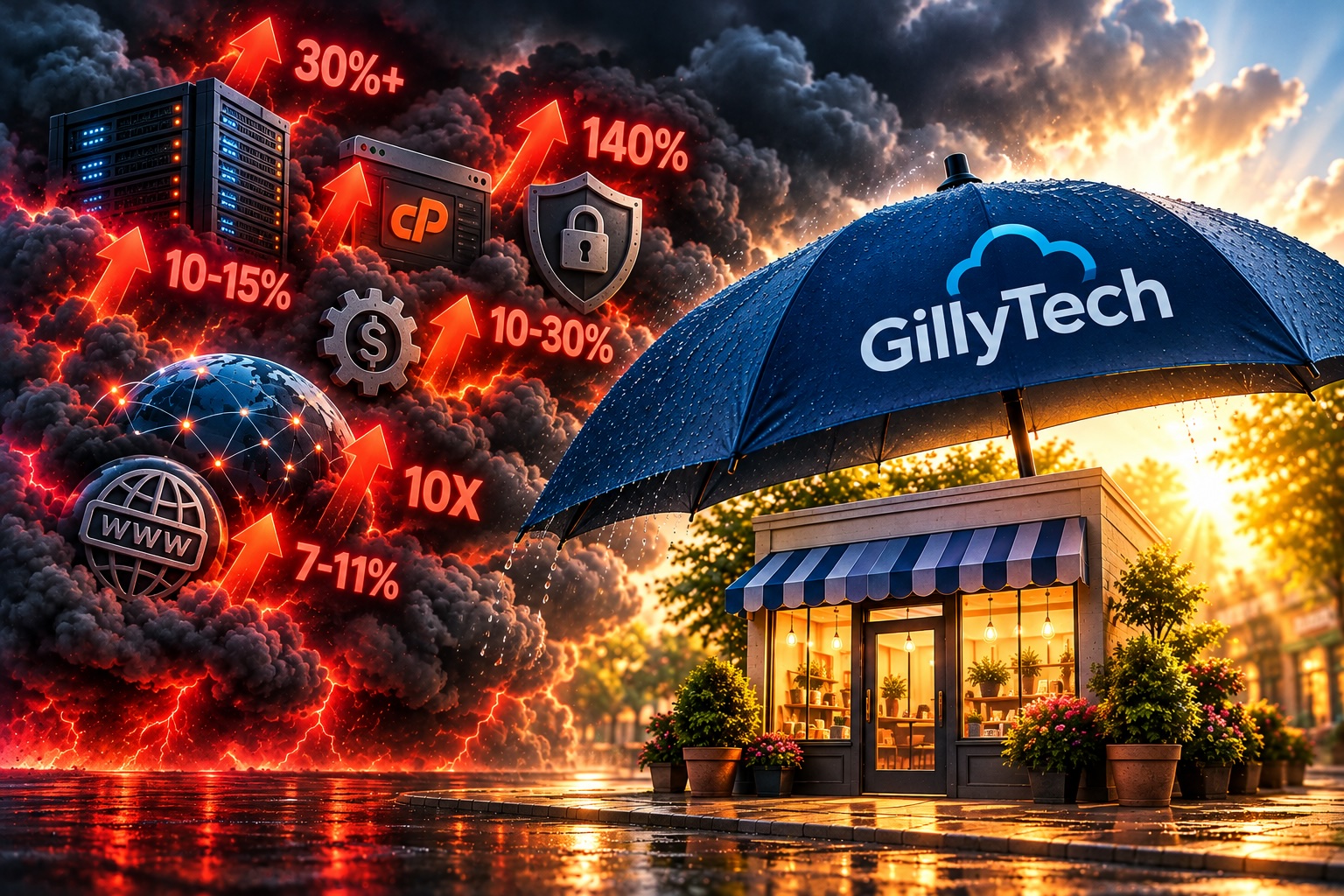
Server hardware: up 30% or more
Every website lives on a physical server somewhere, and servers are mostly memory chips and storage. AI companies are buying those chips faster than factories can make them, and the memory makers have shifted production toward the specialized chips AI hardware needs. Server memory contract prices roughly doubled in a single quarter this year. The result is that the big European cloud providers raised prices across the board this spring, with some plans more than doubling, and industry analysts do not expect supply to catch up until late 2027 at the earliest.
Control panel software: up 10% to 15%, again
The control panel is the software that manages accounts, email, databases, and backups on a hosting server. The industry standard, cPanel, has raised its license prices almost every year since 2019, and this January was no exception: increases of roughly 10% to 15% depending on the plan, which puts the cumulative increase since 2019 at more than 50%. Two weeks ago they told partners that another increase is coming in 2027.
Security and malware protection: top tier up more than 140%
Every properly run hosting server has software that scans for malware, blocks attacks at the firewall, and cleans up anything that gets through. The leading vendor behind that software raised prices in January and then, on October 1, switched to tiered pricing based on how many websites a server hosts. For a server with a full complement of sites, the monthly cost went up more than 140%. The protection is worth it, which is exactly why they can charge for it.
Billing and management tools: up 10% to 30%
Behind every hosting company there is a layer of software that handles invoicing, account provisioning, server isolation, and monitoring. Those tools all repriced in January as well, with increases ranging from about 10% to 30% depending on the product. None of these are optional for a hosting company that wants to run properly.
Content delivery network: roughly 10 to 25 times more
A content delivery network, or CDN, keeps copies of a website in data centers around the world so a visitor in Seattle or London gets the pages from somewhere nearby instead of from a single server in one location. It is a big part of why well-hosted sites load fast. The CDN provider we use announced last week that its pricing structure changes on November 10, and for a typical small business website the cost goes up roughly 10 to 25 times. It also cut the free monthly allowance for image and page optimization earlier this month. This is the single largest percentage increase anywhere in the stack.
Domain names: .com up 7%, .org up nearly 11%
The wholesale cost of a .com domain rises another 7% on November 1. That is the fifth increase in six years, and under the current contract the company that runs .com is allowed to keep raising prices by 7% a year through 2030. It is a business with an 88% gross margin, so this is not about costs. Meanwhile .org went up nearly 11% in June, its first increase in a decade, and .io has an increase scheduled for January. Every registrar adds its own markup on top, so the retail renewal price you see tends to rise by more than the wholesale number.
How It Stacks Up
None of these increases is catastrophic on its own. A few percent here, a flat fee there. The problem is that they are layered. A hosting company does not pay for one of these things, it pays for all of them, for every server and every site, every month. When six vendors each take a bigger slice in the same year, the combined effect on the cost of hosting a single website is significant, and that is before you count the increases that have already been announced for next year.
Most hosting companies handle this the obvious way. If you have ever hosted with one of the large national providers, you have probably seen it: the renewal email that is 20% or 30% higher than last year, the “plan update” that quietly moves you to a new tier, the add-on that used to be included and now is not. That is how the industry works. Costs flow downhill to the customer. Expect to see a lot of that over the next six months.
What We Are Doing Instead
GillyTech is not raising prices on HyperPress or standard hosting. The price on our site today is the price it will be next year.
We are absorbing these increases by getting leaner ourselves. That means consolidating servers so we are paying fewer license fees for the same capacity. It means cutting tools and subscriptions that were nice to have but were not earning their keep. It means automating the routine maintenance work that used to eat hours every week, so those hours go toward the work that actually matters to the people we host. And it means being selective about which vendors we keep, because a provider that raises prices tenfold with a month’s notice is telling you something about how they see their customers.
We would rather tighten our own belt than pass market pressures on to the small businesses that trust us with their websites. Running a business is hard enough. A hosting bill should not be one more thing creeping up every year while the service stays the same.
Why a Small Company Can Do This
This is the whole point of working with a small local company instead of a giant host. We do not have shareholders expecting margin growth every quarter. We do not have a pricing team whose job is to find the next increase customers will tolerate. We have a list of clients we know by name, and the freedom to decide that keeping their costs flat matters more than squeezing out another few percent.
We can make that choice, and we are making it. If your current host has sent you a renewal notice lately that made you wince, here is what HyperPress includes, and the price you see is the price it will still be next year.
Company News
Every Layer Under a Website Got More Expensive This Year. Our Hosting Prices Did Not.
Oct 12, 2026